Doors, Badges, and Blind Spots: Threat-Modeling the Conference Floor
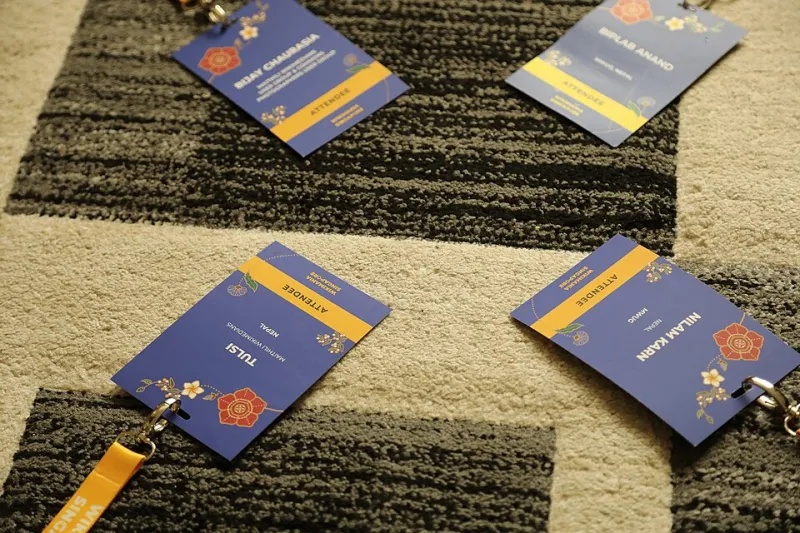
Photo: Bijay Chaurasia, CC BY-SA 4.0, via Wikimedia Commons
The credential hanging around your neck
At a security conference, the most valuable object in the room is usually the laminated rectangle hanging on a branded lanyard. It opens the exhibit floor, the speaker lounge, the networking reception, and — at a growing number of events — the Wi-Fi onboarding portal. It is a credential, and it is treated by nearly everyone in the building as a name tag.
Physical access at conferences is frequently the shortest path to the networks and the people inside them. The paradox is that the population best equipped to recognize this rarely spends fifteen minutes thinking about it, because the mental model of I am attending an event displaces the mental model of I am inside a temporary facility with hundreds of privileged accounts and no meaningful perimeter.
What follows is a field guide, organized the way a site walk would be.
Why conferences are an unusual target
Four properties combine badly. First, population density: a mid-size event puts several thousand people with administrative access to production systems into a few thousand square feet. Second, network density: attendee Wi-Fi, exhibit-hall networks, AV infrastructure, badge printers, digital signage, and vendor demonstration systems, often sharing upstream connectivity and sometimes sharing a VLAN. Third, physical trust: door-propping, escort conventions, and a general assumption that anyone wearing a badge belongs. Fourth, transience: the site is assembled in two days and disassembled in one, so nothing is hardened and nobody has a baseline for normal.
Badge cloning is not exotic
Low-frequency 125 kHz proximity cards remain common for event access control and are trivially clonable with commodity hardware that fits in a jacket pocket. Higher-frequency MIFARE Classic cards have well-documented weaknesses; DESFire and similar cards with proper key management are considerably better, but the deployment matters more than the datasheet. Meanwhile, a large share of conference badges carry nothing more than a printed barcode or a static QR code encoding a registration identifier — a credential that can be photographed from across a lunch table and reprinted at any hotel business center.
For attendees, the practical guidance is short. Do not leave a badge clipped to a bag that spends an hour on the back of a chair. Treat photographs of your badge QR code the way you would treat a photograph of a password. If your badge also serves as a payment or access credential at the venue, ask at registration whether it can be reissued if lost rather than merely reprinted.
For organizers, the controls are equally concrete. Use dynamic or time-bounded codes where the budget permits. Verify at more than one point rather than only at the main entrance. Issue visibly distinct media for staff, press, exhibitors, and speakers, and check that the distinction is enforced at the doors rather than assumed. Keep badge printing equipment off the general network and out of reach of the registration desk's public side.
Social engineering on the exhibition floor
Most floor-level manipulation depends on a small number of scripts. A person in a branded polo asks whether they can leave a laptop bag behind a booth counter. Someone claiming to be from the AV crew asks to be let into a locked room because their badge is in their other jacket. A pair of attendees in conversation drifts through a door held open by a caterer carrying trays.
None of these require technical skill, and all of them work because the cost of saying no feels socially higher than the cost of saying yes. Organizers can reduce the yield substantially with a short volunteer briefing: everyone who needs access to a restricted area has a named contact, a check-in procedure, and an expectation of being challenged. Doors that are supposed to be locked should be checked hourly, and propped doors should be reported without debate.
The AV closet is a network closet
This is the part of the venue that receives the least scrutiny. The lectern laptop, the presentation switcher, the wireless microphone receivers, the confidence monitor, and often a small switch live in a room that is unlocked during load-in and rarely locked afterward. Presenters plug in USB drives. Someone connects a personal laptop to test slides. Hotel engineering and conference AV staff overlap with unclear authority.
Organizers should insist on an AV network that is separate from the attendee network and does not bridge to the internet through an unmanaged device. Presentation machines should be venue-owned where possible, with presenter-supplied media transferred through a controlled process rather than plugged directly into a production machine. Capture-the-flag and hands-on-lab environments should be on their own isolated segment, with a documented egress policy and a named owner.
If you spot something wrong
Security professionals attending an event are in an awkward position: they are guests, they are not the venue's security team, and they may be seeing something entirely innocent. The response should be proportionate.
- Do not confront. An attendee challenging a stranger near a service door escalates a suspicion into a scene and, in the worst case, into a safety problem.
- Record the details while they are fresh: time, location, description, what specifically seemed wrong.
- Find the organizer or venue security rather than posting to social media. Organizers can act; a thread cannot, and a premature post can compromise an investigation or unfairly identify an innocent person.
- If there is an immediate risk to safety — someone forcing a door, a person in distress, an unattended bag — contact venue security or call 911. US venues have protocols for this and they are not improved by well-meaning escalation through conference Slack.
- If you suspect a cloned badge, tell the organizer rather than the badge holder. The holder may be a victim, and the disclosure may tip off the person responsible.
An attendee checklist worth the ten minutes
Before the flight: full-disk encryption on, file sharing and AirDrop restricted to contacts, unnecessary accounts and credentials removed from the device you are carrying, and a decision made in advance that you will not plug in swag USB drives — however clever the branding.
On site: prefer your own hotspot over unknown SSIDs, avoid captive portals that ask for corporate credentials, keep your badge on your person, and assume that anything said in a crowded lounge is public.
And a final item that is not technical. Before the event, tell your team that the conference floor is a hostile environment in the ordinary, physical sense. A five-minute conversation about what to do when something looks off is the cheapest control available, and it is the one most organizations skip.