Perimeter Thinking Is a Liability: The Case for Abandoning Legacy Security Architecture
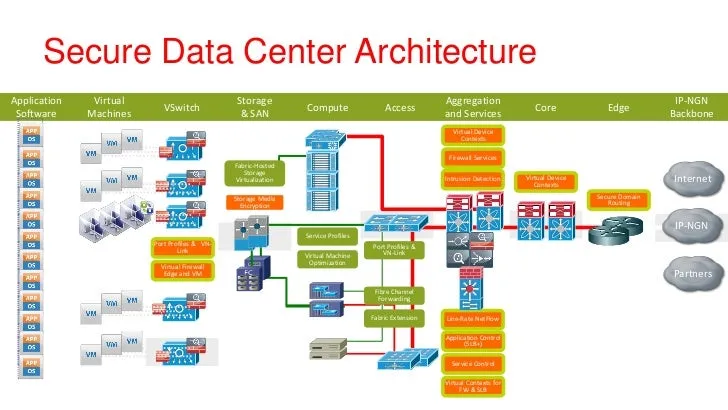
Photo: corporate network security architecture firewall data center, via image.slidesharecdn.com
In the years following the major breach disclosures of the late 2000s, security teams across the United States responded with a predictable and, at the time, rational strategy: build a stronger wall. Firewalls were hardened. Network segmentation became doctrine. The implicit assumption underlying virtually every enterprise security investment was that threats originated outside the organization and that a sufficiently fortified perimeter would keep them there.
That assumption was always imperfect. Today, it is demonstrably dangerous.
The World the Perimeter Was Built For
To understand why legacy frameworks are failing, it is worth revisiting the environment that produced them. In 2009, the majority of enterprise workloads ran on hardware sitting in on-premises data centers. Employees worked from corporate desks, connected to corporate networks, using corporate-issued machines. The attack surface was relatively bounded. A firewall at the network edge, combined with endpoint antivirus and periodic patching, represented a credible defense posture for most organizations.
Security vendors, consultants, and compliance frameworks reinforced this model. The Payment Card Industry Data Security Standard, various federal compliance mandates, and widely adopted frameworks all drew conceptual boundaries between "inside" and "outside" the network. Security teams were measured — and often funded — based on how well they maintained those boundaries.
The model was never perfect. Insider threats, lateral movement following initial compromise, and the inherent trust granted to authenticated users on internal networks were known weaknesses. But for a substantial portion of the 2000s and early 2010s, the perimeter model was good enough to satisfy auditors, executives, and, often, attackers who lacked the sophistication to exploit its limitations at scale.
What Changed — and Why Security Culture Didn't Keep Pace
The erosion of the perimeter did not happen overnight. It accelerated across several intersecting vectors: the migration of workloads to cloud infrastructure, the proliferation of mobile devices, the normalization of third-party vendor access to internal systems, and — most dramatically — the shift to distributed remote work that followed 2020.
Each of these transitions moved meaningful portions of enterprise computing activity beyond the reach of traditional perimeter controls. A user authenticating to a SaaS application from a home network is not behind any organizational firewall. A cloud workload running in AWS or Azure does not sit on a corporate subnet. A contractor accessing a development environment through a VPN tunnel may have credentials, but that does not mean they represent a low-risk actor.
The technical reality changed. The organizational security posture, in many cases, did not.
Part of the reason is institutional inertia. Security programs are expensive to rebuild. The tools, processes, and — critically — the mental models that security teams operate with are deeply embedded in years of training, compliance documentation, and vendor relationships. Telling a CISO that the firewall architecture their team has maintained for a decade is now a liability is not a conversation that produces immediate action.
Part of the reason is also political. Perimeter-based security is legible to non-technical executives. "We have a firewall" is a statement that a board member can understand and feel reassured by. Zero-trust architecture, by contrast, requires explaining concepts like identity-centric access, micro-segmentation, and continuous verification — abstractions that are harder to translate into the kind of confident, simple assurances that executives often expect from security briefings.
The Supply Chain Problem Exposes the Core Flaw
Nothing has illustrated the inadequacy of perimeter thinking more clearly than the supply chain attacks that have dominated security headlines over the past several years. In each case, the adversary did not breach the perimeter directly. Instead, they compromised a trusted third party — a software vendor, a managed service provider, a development toolchain — and used that trust relationship to move laterally into target environments.
From the perspective of a perimeter-based security model, these attacks are nearly invisible. The malicious traffic arrives through authenticated channels. The actors are, technically speaking, "inside" the network. The firewall sees nothing anomalous because the compromise occurred upstream, before the connection was ever initiated.
This is precisely the scenario that zero-trust architecture is designed to address. By eliminating implicit trust — by requiring continuous verification of identity, device health, and access context regardless of network location — organizations can limit the blast radius of a supply chain compromise and detect anomalous behavior that perimeter tools will never flag.
A Roadmap for Security Leaders Ready to Modernize
Transitioning away from perimeter-centric thinking is not a single project. It is an ongoing architectural and cultural shift. For security leaders navigating this process, several principles are worth anchoring to.
Start with identity as the new perimeter. Every access decision should be grounded in verified identity, not network location. Investing in robust identity and access management infrastructure — including multi-factor authentication, privileged access management, and federated identity capabilities — is the foundational step.
Segment by workload, not by subnet. Traditional network segmentation divides infrastructure into broad zones. Micro-segmentation goes further, applying access controls at the workload level so that a compromised system cannot freely communicate with adjacent systems. This limits lateral movement even when an initial compromise succeeds.
Treat every endpoint as untrusted by default. Device health checks, endpoint detection and response tooling, and continuous monitoring should apply to every device accessing organizational resources — including contractor machines and personal devices used under bring-your-own-device policies.
Build visibility before you build controls. Organizations that attempt to enforce zero-trust policies without first establishing comprehensive logging and behavioral baselines tend to generate alert fatigue without improving detection. Invest in centralized logging infrastructure and security information and event management capabilities before deploying enforcement mechanisms.
Communicate the business case, not the technical architecture. Gaining organizational support for a zero-trust transition requires framing the initiative in terms of risk reduction, regulatory posture, and business continuity — not in terms of network diagrams. Security leaders who can connect architecture decisions to business outcomes are far more likely to secure the budget and executive support necessary for sustained change.
The Cost of Delay
The security community has been discussing zero-trust principles since John Kindervag first articulated the model at Forrester Research in 2010. More than a decade later, a significant portion of enterprise security programs in the United States remain organized around perimeter assumptions that those same professionals would acknowledge are outdated.
The gap between what the security industry knows and what organizations actually implement has always existed. But the consequences of that gap are no longer theoretical. They are visible in breach disclosures, regulatory enforcement actions, and the operational disruptions that follow successful intrusions.
The perimeter model was not a failure. It was an appropriate response to the threat environment of its era. The failure would be in treating it as permanent — in allowing the strategies forged in the early 2000s to define security programs operating in a fundamentally different world. For security leaders willing to make the case internally, the path forward is clear, even if the journey is not simple.